Hong Kong Budget 2026: Essential Tax Planning Tips for Expats
Hong Kong has always been one of the best destinations for expatriates because of its low-tax regime, territorial basis of taxation, and simple compliance requirements. However, the dynamic economy and government require updating the fiscal policies through annual budgeting. Expatriates need to stay alert about the changes and plan their finances well in advance before Hong Kong Individual tax return filing.
Case Study
A senior marketing executive who relocated to Hong Kong in 2026 was unaware of how the latest budget would affect her tax obligations. She earned income from employment in Hong Kong as well as overseas investment. Before filing for the Salaries tax return, she secured professional tax advice.
When she reviewed her residency status, housing allowance, investment income, and employment contract according to the updated budget provisions, she identified the allowable deductions, tax concessions for which she was eligible, and the reporting requirements. She restructured it and claimed the deductions and employment benefits.
This helped her in reducing the tax liability to 12% effective tax rate while being fully compliant with the Hong Kong tax laws.
Hong Kong Budget 2026
Presently, when the international tax transparency system, cross-border investments, global mobility setup, and remote work arrangements are getting reformed, the Hong Kong Budget 2026/27 has arrived. Carefully studying and understanding the latest tax system can help you improve your financial position while being compliant.
Key Takeaways
- There is a 100% reduction of salaries tax and tax as mentioned under the Personal Assessment for the year of assessment 2025/26, subject to an HKD 3,000 cap.
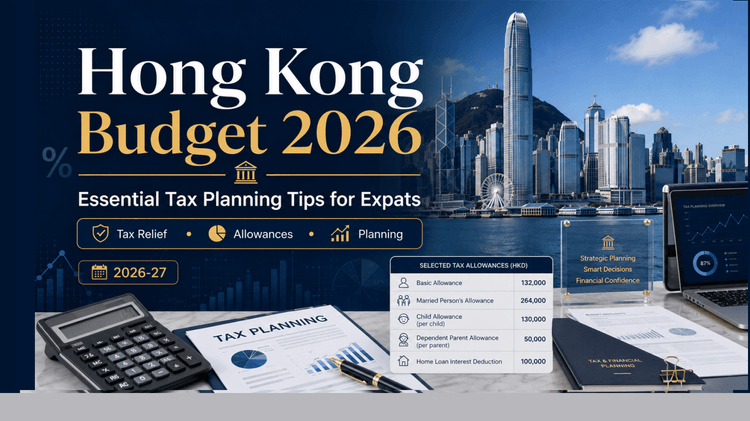
- The budget 2026/27 has further proposed an increase in various allowances starting from the assessment year 2026/27 as mentioned in the table below.
Personal Allowances in Hong Kong | ||
Type | 2024/25 and 2025/26 (HK$) | 2026/27 and onwards (HK$) |
Basic allowance | 132,000 | 145,000 |
Married person’s allowance | 264,000 | 290,000 |
Child allowance (for each of the first to ninth child) | 130,000 | 140,000 |
For each child born during the year, the child allowance will be increased by: | 130,000 | 140,000 |
Dependent brother or sister allowance (for each dependant) | 37,500 | 37,500 |
Dependent parent and dependent grandparent allowance – aged 60 or above or eligible under disability allowance scheme | 50,000 | 55,000 |
Dependent parent and dependent grandparent allowance – aged 55 to 59 | 25,000 | 27,500 |
Additional dependent parent and dependent grandparent allowance – aged 60 or above or eligible under disability allowance scheme | 50,000 | 55,000 |
Additional dependent parent and dependent grandparent allowance – aged 55 to 59 | 25,000 | 27,500 |
Single parent allowance | 132,000 | 145,000 |
Personal disability allowance | 75,000 | 75,000 |
Disabled dependant allowance (for each dependant) | 75,000 | 75,000 |
*Please note that legislative amendments are needed to implement the tax measures that have been proposed by the Financial Secretary in the budget of 2026-27.
- The deduction for families caring for elderly relatives has been proposed to be increased from HKD 100,000 to HKD 110,000 starting from the year of assessment 2026/27.
- The standard tax rate and progressive tax rate for salaries remain the same.
Standard Tax Rates:
First HKD 5 million of net income: 15%
Remainder: 16%
Progressive Rates:
First HKD 50,000 – 2%
Next HKD 50,000 – 6%
Next HKD 50,000 – 10%
Next HKD 50,000 – 14%
Remainder – 17%
Further in this blog, you will be reading about the tax planning tips for expats who are living and working in Hong Kong in 2026. But first, let’s read why Hong Kong tax planning is necessary for expats.
Why Tax Planning Has Become Essential for Expats?
While Hong Kong is known for its simple tax structure, it does not mean that there is no need for tax planning. Expats have complex financial arrangements as compared to residents, and therefore, they need to be proactive and plan wisely.
The structure is different for expats when it comes to overseas investments, rental income from home countries, pension contributions in multiple jurisdictions, stock options, share awards, foreign bank accounts, and cross-border arrangements. In the absence of proper tax planning, the payer might have to bear unexpected tax liabilities.
Tax planning helps in structuring your financial affairs well so that unnecessary double taxation can be avoided.
10 Tax Planning Strategies for Expats in Hong Kong in 2026
Whether you are residing or working in Hong Kong, expats need to be aware of the latest tax structure so that they can do strategic tax planning. Here are 10 tax planning tips to help you optimise your finances
1. Review Your Employment Structure
You should be aware of the employment structure, as it can help you save taxes to a huge extent. There are questions which an expat must ask themselves, like is my employment offshore or Hong Kong employment? Do I travel frequently for work outside Hong Kong? Can I claim days outside for relief, and what are the taxation rules for bonus and stock compensation?
These questions become necessary because substantial time spent outside Hong Kong for work may qualify for partial tax relief if eligible through Hong Kong offshore claim. This is why expats should maintain their travel records.
Please note that a 60-day rule is followed in Hong Kong for expats, which means that those who have been working for less than 60 days in the assessment year are exempt from Salaries tax.
2. Maximise Allowed Deductions
One of the most common ways of reducing payable tax is by utilising deductions well. Usually, expatriates fail to take advantage of these deductions, which are legally approved. Potential deductions may include Mandatory Provident Fund (MPF) Contributions, Voluntary Health Insurance Scheme (VHIS), Self-Education Expenses, Home Loan Interest, and Charitable Donations.
Tax Deductions in Hong Kong | |||
Assessment | % of tax reduction | Maximum per case (HK$) | Applicable tax types |
2020/21 and 2021/22 | 100% | 10,000 | Profits tax, salaries tax, and tax under personal assessment |
2022/23 | 100% | 6,000 | Profits tax, salaries tax, and tax under personal assessment |
2023/24 | 100% | 3,000 | Profits tax, salaries tax, and tax under personal assessment |
2024/25 | 100% | 1,500 | Profits tax, salaries tax, and tax under personal assessment |
2025/26 * | 100% | 3,000 | Profits tax, salaries tax, and tax under personal assessment |
*Please note that legislative amendments are needed to implement the tax measures that have been proposed by the Financial Secretary in the budget of 2026-27.
3. Check Stock Options and Equity Compensation
There are many expatriates who have been benefiting from receiving compensation through Restricted stock units (RSUs), employee stock purchase plans, share options, and performance shares. There are critical considerations as well, which include vesting dates, international tax treaties, exercise dates and employment location during the vesting period.
Expats should always get professional tax advice before buying or selling shares. Improper planning can lead to tax payments in multiple jurisdictions.
4. Harmonise Hong Kong Tax with Home-Country Obligations
An expat may get exposed to dual-country tax obligation, this why there must be proper synchronization between the home country and Hong Kong Tax obligations. The United States, Australia, the United Kingdom, Canada, and European countries may have obligations even when the income has been taxed in Hong Kong.
5. Efficient Management of Rental and Property Income
The expat rental income in Hong Kong is taxable at a standard Property Tax rate which is 15%. The budget 2026/27 has not changed the core tax rate when it comes to property. However, the expats may choose a Personal Assessment if it leads to lower tax liability.
Also, expats may have property in their home country, getting them income in the form of residential rental, commercial property income or short-term holiday rentals. While it is not always taxable in Hong Kong tax due diligence, it may be taxable in the home country.
Therefore, the expat must have proper rental agreements, expense receipts, mortgage records, and property tax documentation, as they help in reducing the taxable profits.
6. Use Retirement Planning Opportunities
Expats may be on a project basis in Hong Kong, which may reduce their interest in the retirement plans. However, retirement planning can lead to long-term tax efficiency. There are certain areas which should be evaluated, such as voluntary retirement contributions, MPF participation, overseas pension schemes, and employer retirement plans.
The 2026-27 Hong Kong Budget maintains the tax-deductible limit of HK$60,000 for voluntary Mandatory Provident Fund (MPF) contributions and Qualifying Deferred Annuity Policies (QDAP).
7. Monitor Tax Residency Status
Hong Kong tax residency status has gained importance worldwide as it is helpful in determining the right place where the taxes are to be paid. Working in multiple countries can make a person establish tax residency in all of them unintentionally. There are certain factors, such as family location, economic ties, employment, days spent in the jurisdiction, and permanent home, which help in deciding the tax residency. Expats must track their travel and review their residency status every year. Taxpayers may apply for a Hong Kong Certificate of Resident ("CoR") to avoid double taxation.
8. Separate Personal and Business Books
Many expats establish trading companies, startups, or consulting businesses. But what mistake they make is that they forget to keep the personal and business transactions separate. Hong Kong Profits tax filing can be done efficiently when you have maintained detailed records distinctly.
It is suggested that if you are doing business, then it is best to keep your bank account separate. There should be proper documentation of expenses, and the taxes should be reviewed annually. Maintaining your accounts well helps in auditing and simplifying tax payment calculations.
9. Be Open to Increased Information Sharing
Global tax authorities cooperate, and therefore, you must be ready for information sharing. The financial institutions report account details as required by the international information frameworks. Therefore, expats should disclose foreign accounts where needed, and the tax returns must be consistent across jurisdictions to avoid any complications.
10. Start Planning Before Year-End
Expats should do their tax planning before the tax year closes, as this provides ample time for effective decision-making. Waiting for the next tax filing season can lead to losing tax-saving opportunities. You must review the income projections, deductions available, bonus timings, equity compensation events, retirement contributions and the property transaction.
Hong Kong undoubtedly has the world’s best tax jurisdiction for expatriates. However, the taxpayer should be proactive and must go through all the deductions available carefully to optimise their finances. Expats should know the rules, update their tax residency annually, maintain proper accounts and keep documents safely for successful Hong Kong Budget 2026 expat tax planning. As global tax transparency is growing, smart tax planning has become all the more necessary.